
Flat water starting a smaller Foil Drive board with Tom Earl
Once you've progressed off your first Foil Drive board, the next step is usually a smaller one, and flat water starting is where most riders get stuck. In this tutorial Tom Earl runs through two methods of getting to your feet, and the weight and pitch control that makes both of them work.
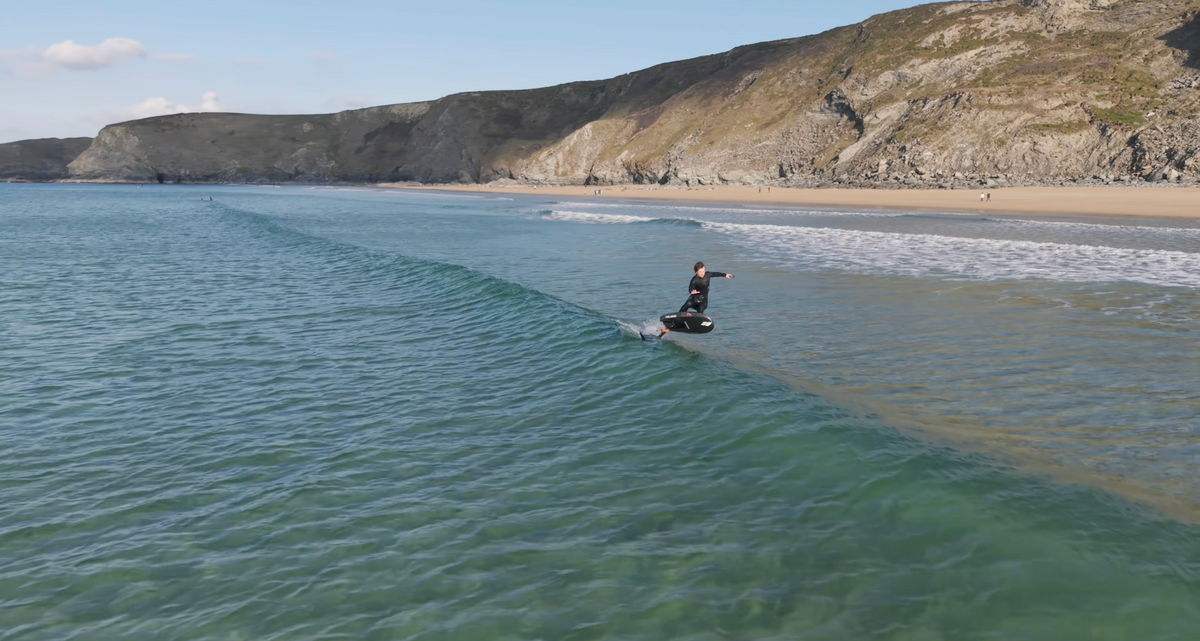
Tom is 175cm (5'9") and 80kg (176lb), riding the Nano RTS 4'3" 34L with a Code 890X foil. To keep it a fair comparison, he's running the standard black propellers.
The Nano RTS is made for high intermediate and advanced riders, not beginners. In this video Tom isn't pushing a small board to its limits. At around 80kg (176lb), he's well within the 34L's comfortable range, so a rider of similar weight and ability can expect the same.
Starting position
A smaller board is less buoyant and sits submerged when you're lying on it. Tom starts with his hips right back on the tail. This lifts the nose out of the water, so he can rest the remote on it and get a clear signal to the unit. The controller needs to stay on the deck until pop up - otherwise the signal can drop out if there is too much water interference between.
As the board starts moving, he brings his weight further up the board, a little more as speed builds. On a bigger board you can lie almost anywhere and it will still get going. On a smaller board you need to keep it level, and give it time to build speed before you try to stand.

Method 1: Knees up first
Once the board is planing on the surface, bring your knees up. Keep your hands on the board while you place your front foot, and only take them off once you're on your feet and settled and the board releases from the water. Taking your time here leads to far more successful pop-ups.
When popping up, look up, not down at your feet. This is especially important when bringing the back foot up from the knees, but it matters in Method 2 as well.

Weight distribution and pitch
On a smaller board, where you put your weight matters even more. Most mistakes come from not moving around the board enough to get it to an efficient planing angle. This angle is where the nose and tail of the board run parallel along the surface of the water.
- Too far back: the board pushes water, uses more battery than it needs to, or doesn't get going at all.
- Too far forward: the nose dips and stalls and the board won't get going.
A smaller board is also more pitch sensitive. Keep your hands on the deck until both feet are set, and use them to push the nose down and hold the pitch level.

Method 2: Back foot first
This is Tom's preferred method. Everything is the same until the board is planing on the surface. Then he brings his back foot up first and places his front foot after it. He finds it a cleaner way of getting going, but some riders prefer knees up. Try both and see which suits you.
With either method, it comes down to moving your body weight to keep the board at an efficient planing angle, so it builds speed as efficiently as possible. How hard you push down on the nose with your hands controls that angle, and your hands stay on the board until your feet are set and can take over.

Technique over board size
Tom's point is that efficient technique really matters when moving to a smaller board.
When you're starting out, a bigger board makes up for a lack of technique. With the right technique, smaller equipment opens up a lot more freedom on a wave once you're unpowered.

